

Customers are now seeking convenience even before they arrive at the restaurant, from browsing menus online to planning their orders.
And digital menu QR codes play a crucial role in providing so.
Today, they offer faster service, real-time menu updates, seamless ordering, and a more customer-friendly experience that modern diners expect.
If you need more than just menu access, MENU TIGER offers an all-in-one solution designed to support both customer experience and overall restaurant operations.
This guide walks you through how to create a digital menu QR code in MENU TIGER and how to get the most out of it.
What’s a digital menu QR code?
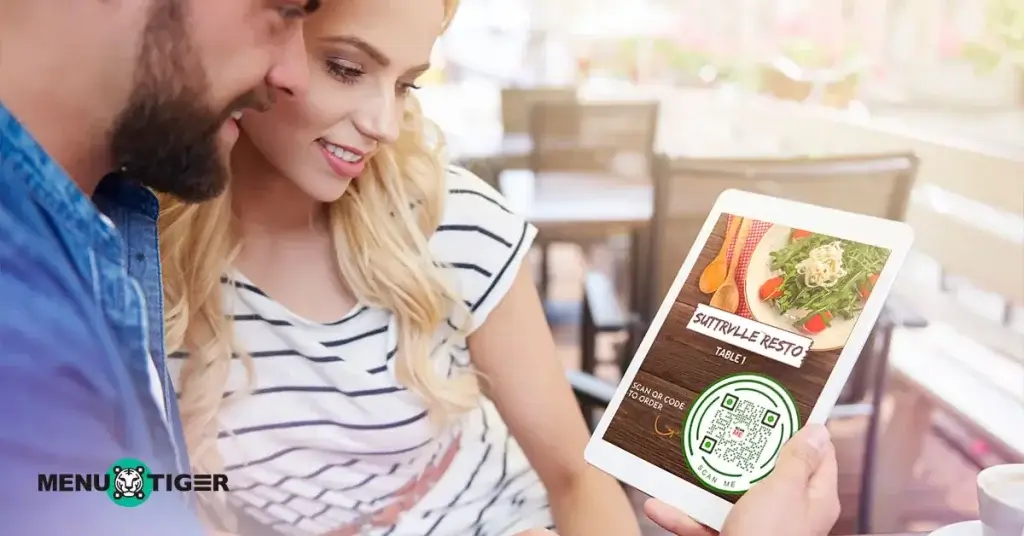
A digital menu QR code is a two-dimensional barcode that stores data such as an online menu, restaurant website information, and payment details.
When a customer scans a QR code menu through a mobile device camera, it opens the menu instantly. No app needed.
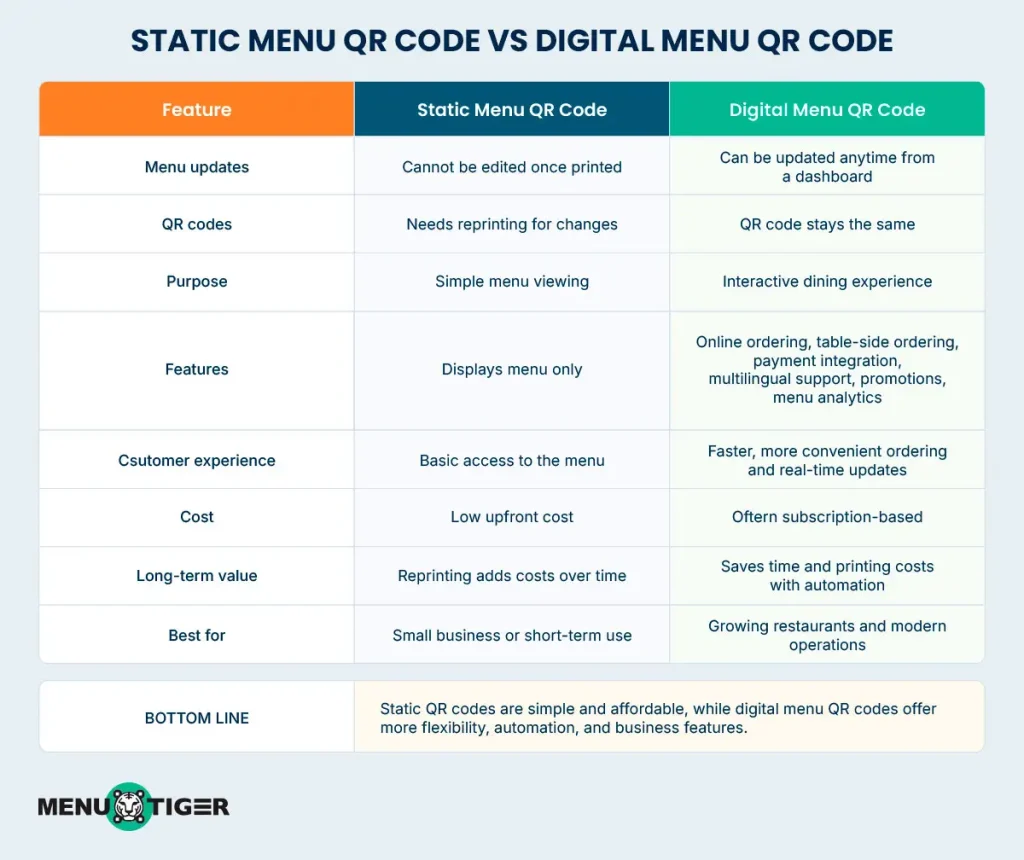
One important distinction: a static menu QR code and a digital (dynamic) QR code are not the same thing, even though both display on a screen.
Static vs. Digital menu QR code

7 steps to create a menu digital QR code in MENU TIGER
If you’re planning to upgrade from your static menu or traditional paper sheets to a digital one but don’t know where to start, here’s an easy-to-follow guide using MENU TIGER:
Step 1: Go to the MENU TIGER website and click Start Free.
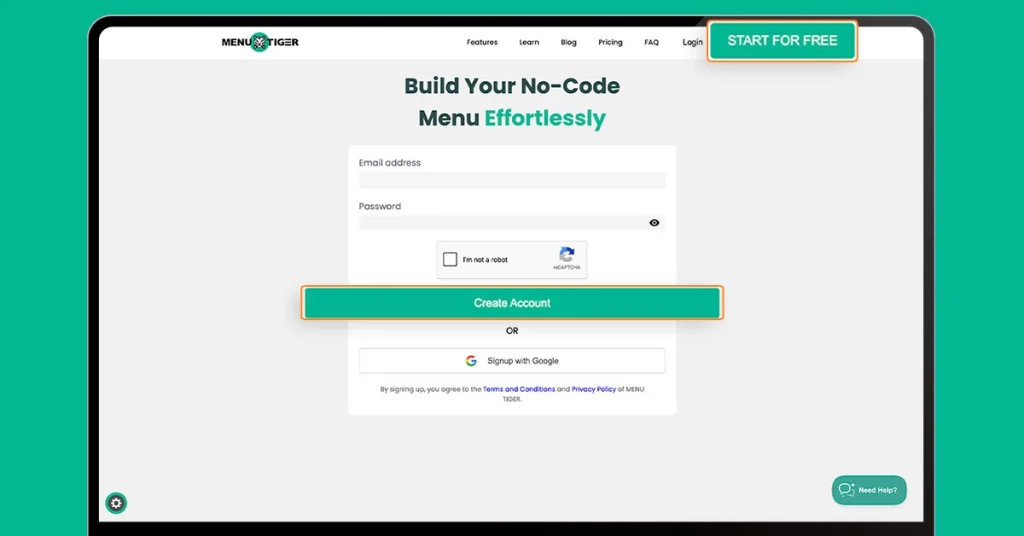
Create an account or sign up with Google and provide the necessary contact information.
If you have a MENU TIGER account, enter your email address and password.
Step 2: Go to Menus on the left side of the dashboard.
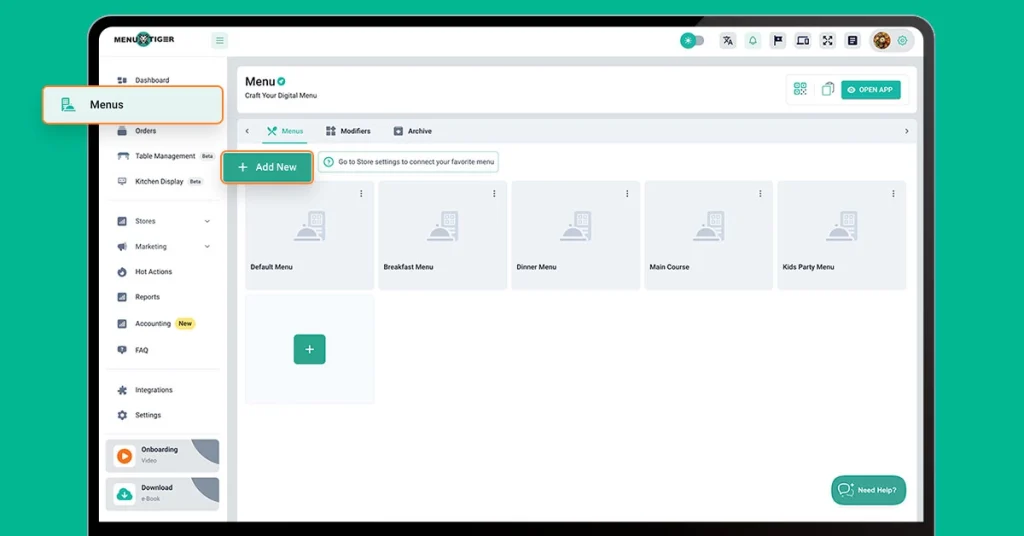
Click +Add New to add your food items.
You have three options here: You can build your virtual menu from scratch, import from a spreadsheet, or upload your printed menu to the free AI menu maker to turn it into a digital version in an instant.
Step 3: Create the menu categories.
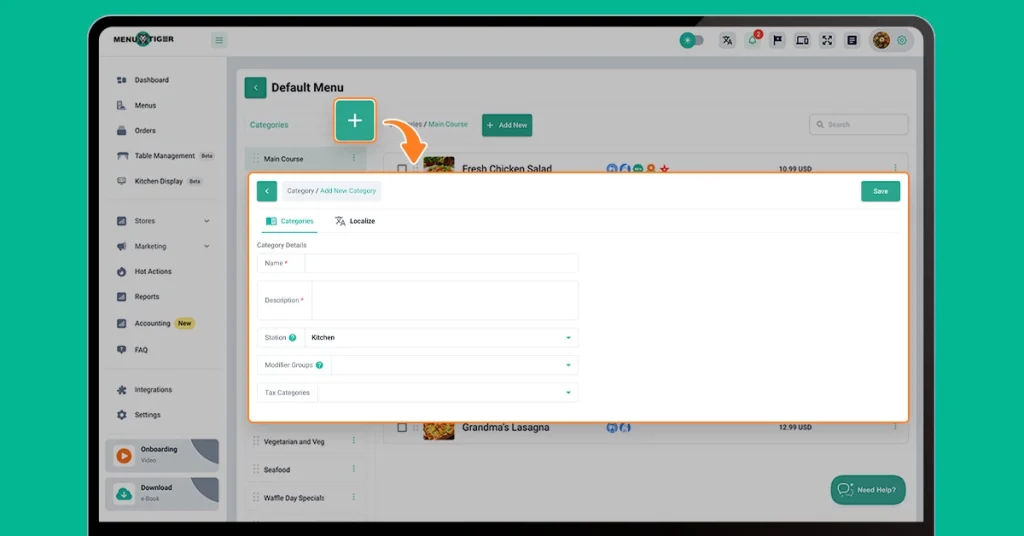
Select the plus (+) sign beside Categories and fill in the boxes with the complete information.
Step 4: Add your menu items.
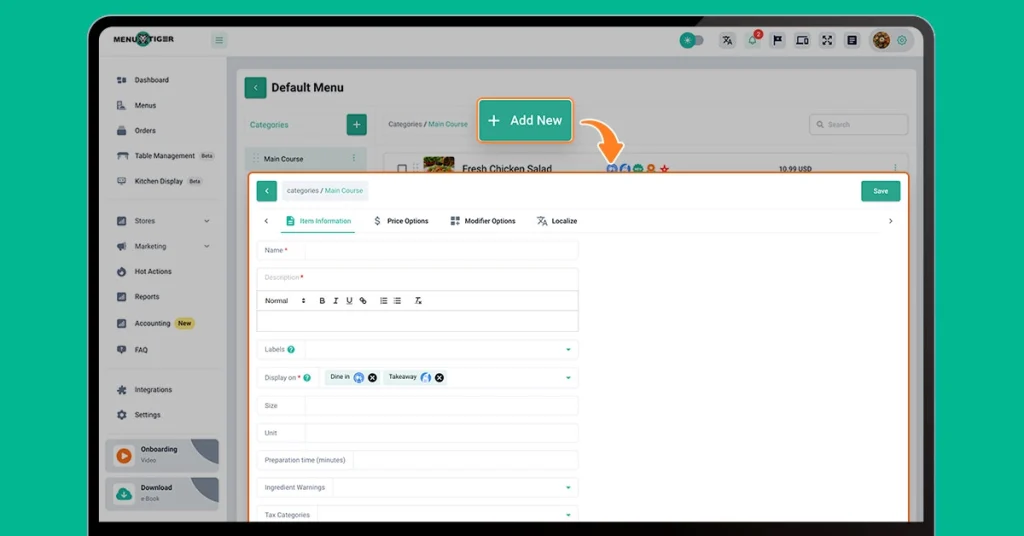
Choose the category you’ll add the item to and click the +Add New button.
Ensure that you supply all information required, from item information, price options, to its modification options.
Remember to save the changes before going to the next step.
Step 5. Go to Stores and set up your restaurant.
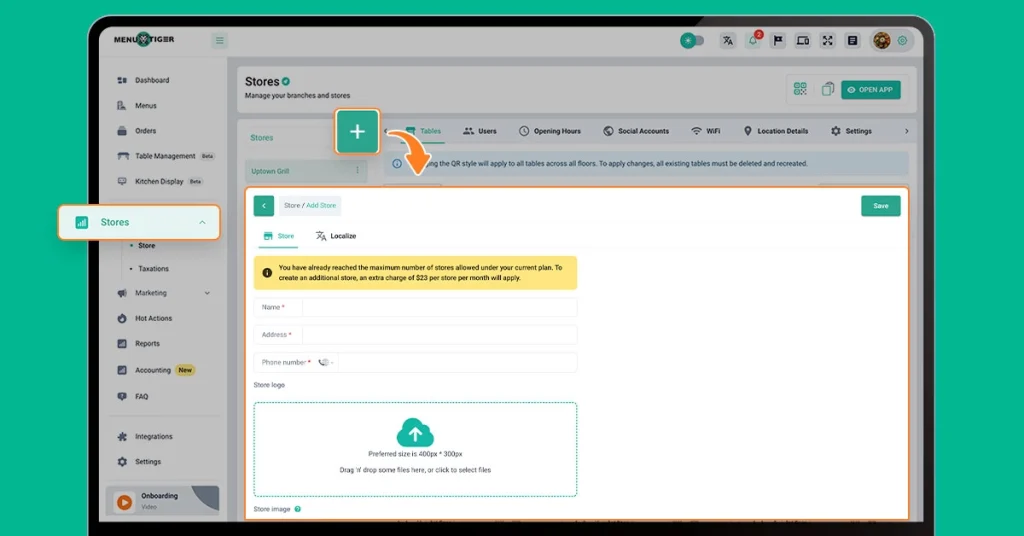
Set up your restaurant and make sure to complete the name, address, contact information, the logo, and your store image.
Click Save once you’re done.
Step 6: Select your store name and go to Settings.
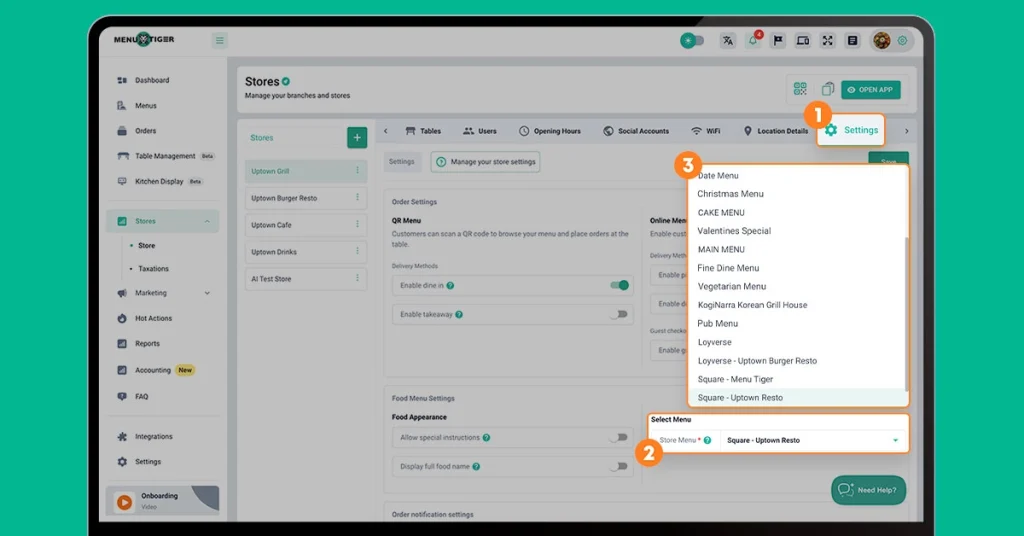
Select the toggle on Store Menu and choose the virtual menu you set up in steps 2, 3, and 4.
Once done, save the changes.
Step 7: Go to the Tables section, add the floor, and input the number of tables available.
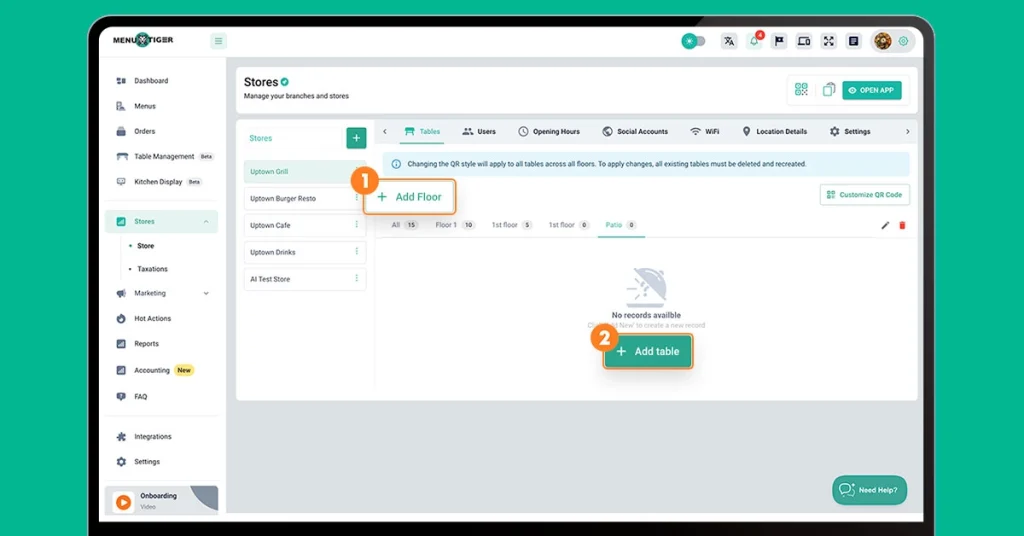
Go over to the +Add floor, input which floor you’ll be using your QR code menu, and add the number of tables you have on that specific floor.
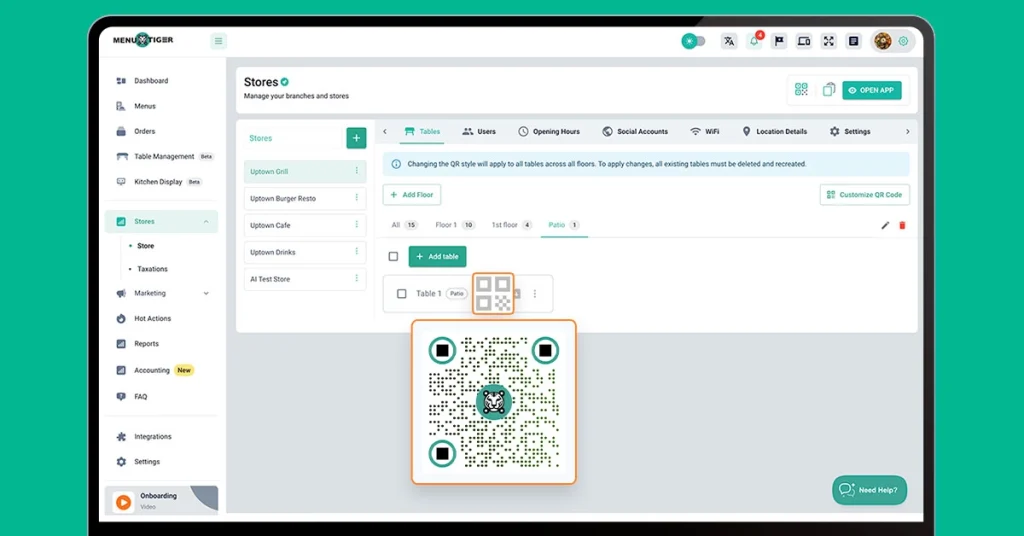
Once added, you’ll automatically have your unique menu digital QR code for each table.
If you want to customize them, click Customize QR Code located on the right side.
5 tips to use digital menus effectively
Here’s how to use a QR code menu effectively, especially if it’s a new addition to your operation:
1. Keep physical menus available during the transition
Not every customer is comfortable with QR codes. Forcing the shift immediately creates friction—and bad reviews.
So, instead of making QR menus mandatory right away, treat them as a parallel option during the transition phase.
A smoother setup would be like this:
- Menu QR codes are placed on tables
- Few physical menus are still available upon request
- Staff trained to assist first-time users
This can reduce friction and prevent customers from feeling inconvenienced.
2. Train staff to introduce smart QR code menus naturally
Technology fails when the people presenting it aren’t confident using it. Run a short team training that covers:
- How the QR system works
- How to troubleshoot if there are scanning issues
- How to explain features without being too technical
- How to assist less tech-oriented guests
If your staff seems uncertain, the customers will hesitate to use it too.
3. Place QR codes where customers can see them
Good placements: table tents, table corners, counter displays, and walk-in signage.
Avoid: poor lighting, cluttered designs, and small print sizes.
Always add a clear call to action. “Scan to view the menu” or “Order directly from your phone” tells customers exactly what to do and why it’s worth it.
4. Optimize digital menus for speed and simplicity.
Your digital menus should make ordering easier, so test them out and see if it crosses off the checklist:
- Fast loading speed
- Mobile-friendly design
- clear menu categories
- Readable fonts
- Simple navigation
This way, you’re preventing frustration that causes slow table turnover or bad reviews.
5. Use it to sell, not just display
A digital menu is more than a list. Use it strategically:
- Feature high-margin items in a best-sellers section
- Run time-limited promotions directly on the menu
- Use item descriptions and food photography to guide purchasing decisions
Why digital restaurant QR code menus work
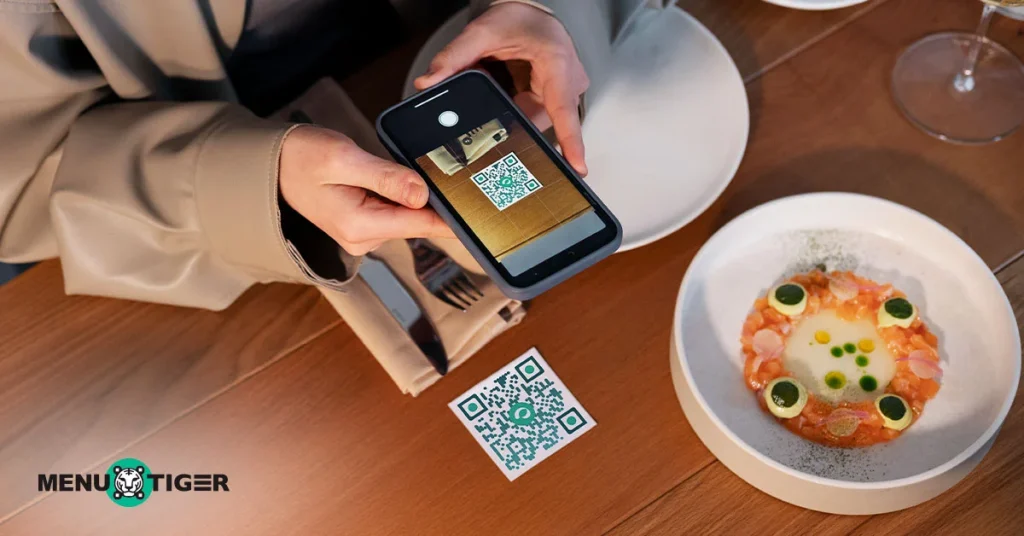
Most industry reports describe QR code menus as simply contactless or convenient.
But in reality, digital menus change the trajectory of how restaurants operate, sell, market, and manage their customers.
They turn your menu into a revenue tool.
A printed menu is passive—it can’t react, adapt, or guide purchasing behavior. A digital QR menu can.
Because it’s built to help restaurant owners sell, manage, and market, they can strategically position high-margin dishes first, highlight an add-on per item, or push a limited offer, all in your customers’ devices.
They influence how much customers spend.
Menu psychology is well-documented in print. Digital menus introduce a different dynamic.
Research shows that using this digital menu technology has brought 18% to 23% higher repeat visit rate and 35% higher average order value.
The primary influence in this surge is the scroll behavior and sequential attention. Unlike paper menus, customers have a spatial view of all options, despite strategically arranging your items.
Another factor to point out is the high-quality food photography of the dishes. Research emphasized that saturated and vibrant food images on screen encourage purchase more than the printed ones.
They speed up table turnover.
Long wait times, particularly in order-taking, stagger restaurant operations and efficiency.
Some customers are in long queues, waiting for staff assistance, or simply staring at the menu sheet, while others at the other table wait for their turn.
With QR codes on table tents, these shorten the process. Customers can access your menu, order, and pay, all done using their mobile phones.
This gives diners control since they can interact with the menu on their own terms—no stress or pressure, which pushes for faster ordering, leading to a better turnover.
Restaurants report an average time reduction of 8 to 12 minutes per table from seating to order. If you’re covering 20 tables during peak hours, an extra turn per table means additional covers.
They simplify multi-location management.
Running multiple locations without synchronized menu management creates compounding problems: inconsistent offerings, untracked stock, unresolved complaints.
MENU TIGER’s multi-location support puts all branches under one dashboard. Update a menu item once—it reflects everywhere.
They future-proof your restaurant operations.
The continuous change in customer behavior urges the industry to keep up with it.
Contactless payment has been at the forefront of customer purchasing needs. They want an easy and convenient way to pay the bill.
According to restaurant industry statistics reports, 25% of customers prefer digital payment methods over the physical ones, and 43% of millennials and Gen Z diners—which covers most demographics to eat out often—opt for the same when dining.
With QR codes adopted in operations, you’re not just upgrading your workflow but setting it for future needs.
The QR code menu ordering system market: Where it’s heading
The restaurant industry is no longer treating digital menu QR codes as a trend or a pandemic-era solution.
The numbers have shown that digital dining experiences and menu trends are becoming a long-term restaurant operation.
Apparently, the QR menu market is exponentially growing every year, reaching an estimated $3.1 billion market value in the coming years.
And today we are seeing;
- 78% of diners prefer using QR code restaurant menus
- 88% of the restaurant owners plan to continue using digital menu
- QR code payments are projected to increase by 240%
This clearly states the reality: restaurants are moving toward a fully connected, mobile-first dining ecosystem.
And that is exactly where MENU TIGER is positioning itself.
The future of QR menu systems is no longer about replacing printed menus because modern platforms like MENU TIGER are moving to evolve them into operational hubs that connect ordering down to management all in one tech.
Scan, Order, and Experience: Smart dining starts here
Digital menu QR code technology is helping restaurants modernize how they serve, sell, and communicate with guests.
Real-time updates, contactless ordering, targeted promotions, and operational efficiency aren’t features of the future—they’re available now.
And MENU TIGER gives you all of it in one place. Start for free today.