
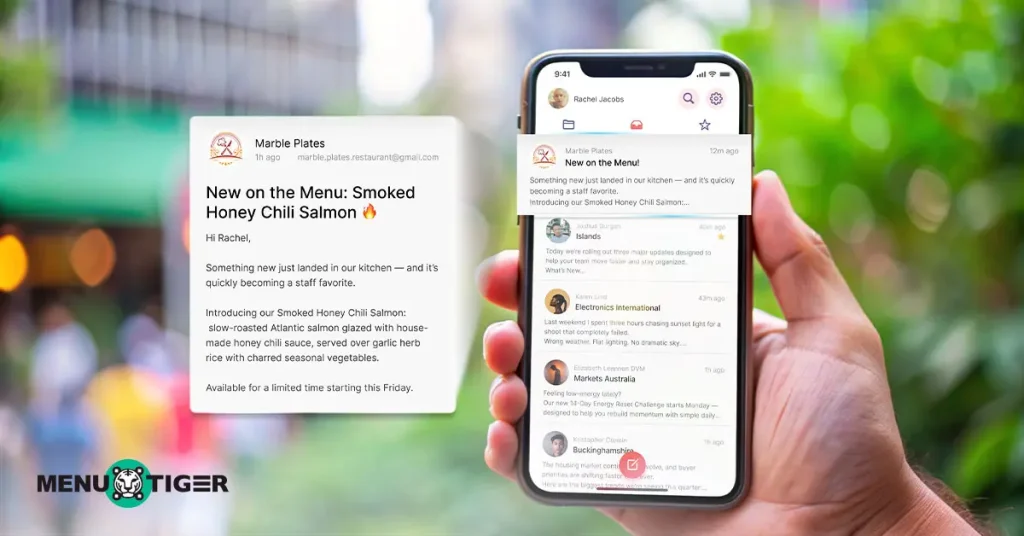
Email is one of the few marketing channels that allow marketers to communicate with customers directly.
No algorithm decides whether your message gets seen—if someone’s on your list, you can reach them directly.
The catch? Most restaurant email marketing campaigns are forgettable.
This guide covers that and more, including email content you can use and the best practices to help you fill your restaurant.
Is email marketing good for restaurants?
Yes, email marketing is good for restaurants.
According to 2023 data from Statista, more than 50% of marketing professionals reported a 100% improvement rate in their email marketing campaign return on investment (ROI).
Aside from the ROI, email is cheap to run, easy to personalize, and straightforward to measure.
It also directly connects you to your customers, creating the foundation of a strong and consistent relationship.

Every step to running a successful restaurant email marketing campaign

Having the tool is only half the job. Here’s how to actually make it work:
1. Refine how you define your restaurant
You already know what sets your business apart from your competitors.
This should be evident in your restaurant marketing ideas whether on Google Ads or on your social media.
Email marketing, however, allows you to focus on specific aspects of your brand. Refining how you define your restaurant will build the foundation for all email marketing campaigns going forward.
When determining what makes your restaurant distinct, look at why your customers choose your restaurant in the first place.
Do they come here for the ambiance? Is your menu unique? Is it the speed with which food is served? Whatever the answer is, stick it into your messaging every chance you get.
2. Set SMART goals
Every campaign has goals to achieve, but successful ones work to accomplish specific, measurable, achievable, relevant, and time-bound goals.
Otherwise known as SMART goals, defining your campaign objectives this way leads to more efficient planning.
For example, you have a special Valentine’s Day menu that you want to promote to your email subscribers. If this is how you set your goal, then simply featuring the menu in your email should be enough.
However, if your goal is to attain 50 reservations during the week of Valentine’s Day after sending out your emails for Valentine’s menu prom, then your strategy will have to be better than pasting your menu in the email body.
3. Grow and organize your restaurant email list
You should be making a consistent effort to grow your email list to expand the reach of your campaigns.
Use feedback forms, online reservation forms, and special giveaways to get diners to provide their email addresses.
After you’ve built a sizable list, begin segmenting your contacts to make targeting campaigns easier to organize.
Find out trends in your customer base and divide your list according to patterns you notice.
4. Choose the right incentive
Once you know who you’re talking to and what you want them to do, the incentive becomes obvious.
Frequent diners? Invite them to a restaurant loyalty program or reward promos. Lapsed customers?
A limited-time offer might be enough to bring them back. Match the incentive to the behavior you want.
5. Use the best email marketing platform
You’ll need a solid restaurant marketing tool to run campaigns at any real scale.
This kind of application has features that can help facilitate campaigns of any size, such as:
- Pre-built email templates
- Automation tools
- Email list segmentation
- Analytics
- Third-party software integrations
The best platforms will often come at a price, but you aren’t restricted to software that exclusively serves email campaigns.
Customer relationship management software is a general marketing hub for any business, while a restaurant order management system may also come with email marketing tools.
Once you have software like this, you can get right into starting your campaign.
Emails that will catch a diner’s attention
Steps are covered. Now, here are the kinds of content you can use to increase restaurant sales and retain diners:
Welcome emails
The moment someone joins your list, send a welcome email.
Welcome emails are also the perfect opportunity to show diners what your restaurant has to offer.
First impressions last, and this kind of email sets the tone for future visits to your restaurant.
Confirmations and reminders for reservations
Customers will always appreciate confirmations of their reservations.
Doing this lets customers know that you’ve received their request and will have a table ready when they arrive.
Reminding diners of them is also a good idea, especially when their reservations are weeks or even months away.
From their perspective, you look accommodating and eager to serve them. On your end, you ensure that not a single table is empty.
Birthday or anniversary emails
An effective strategy in email marketing for restaurants is sending birthday or anniversary greetings to old customers.
Doing so establishes a more intimate connection and keeps them from being just a table reservation.
Obviously, you can’t just send them a greeting to get them back to the table.
Give diners an exclusive promo on their special day to get them to celebrate with you.
Post-dining follow-ups and feedback
Knowing what your customers think of your services allows you to better serve them in the future.
This kind of email also opens a line of communication that shows diners that their opinions matter and gives you the chance to thank them for dining with you.
Reviews and awards
If you’ve earned recognition, don’t let it sit in the folder.
Awards and good reviews are earned, so why not share them with your email subscribers if you have them?
Reviews from food critics and awards from magazines should definitely be in your email, but feel free to include positive reviews from diners.
Feedback from post-dining emails is also a worthy addition to this type of email, and will surely leave a good impression on your customers.
New menu announcement
An announcement of your new menu is news that should also be spread through email.
Whether you’re promoting a redone QR code menu or announcing a seasonal menu, letting your email subscribers know ensures you reach as many people as you possibly can.
Thinking of adding more to this kind of marketing email? Include an overview of the new menu to further entice your diners to try it out.
Highlight a specific menu item.
Speaking of menus, you can also promote a specific menu item to your subscribers.
According to TouchBistro, 62% of diners are willing to visit a restaurant when they have a limited-time offering.
If you have an exclusive meal like this, send out an email blast about it to spread the word.
On the other hand, if a staple dish is making a comeback, featuring it in this kind of email can also attract new customers and regular diners alike.
Recipe newsletters
In case you have customers who also love to cook, sending a restaurant newsletter is a great way to build a bond between them and your restaurant.
Choose meals from the current or past menus, and send subscribers their recipes on a weekly or monthly basis to share your passion for the culinary arts.
Loyalty programs
Loyalty programs are everywhere, and that’s because they work.
If you’re launching one, it’s a good idea to let your email subscribers in on the new promotion using your QR code menu.
Using the email format in this way also allows you to break down the loyalty mechanics much more easily and makes the information even more accessible by making it digital.
Social media promotion
While emails are an effective marketing channel, GWI’s data from 2024 shows us that 94.4% of online adults use social networks at least once a month.
Therefore, promoting your social media pages in your emails will do a lot to drive traffic to your profiles, opening up even more lines of communication.
Event invitation
If your restaurant holds events like tastings or farm-to-table dinners, your email subscribers should be the first people you inform about them.
Not only are you inviting them to experiences they won’t forget, but you’ll let them know that when it comes to special moments, they are who you think of first.
Email marketing for restaurants: The do’s and don’ts
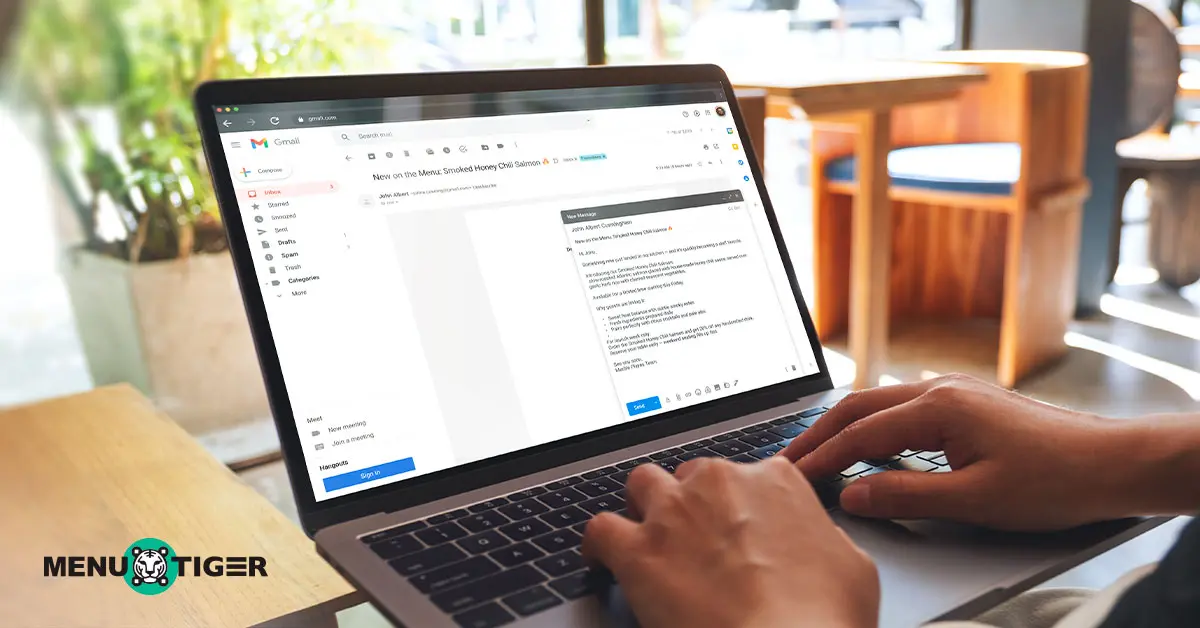
You have the steps and the content, but you still need more than that if you want your emails to achieve any meaningful results. The actions listed below will do the trick.
Grow your email list ethically.
When collecting contacts for your email list, be sure you’re doing it with their permission.
That means only getting email addresses from customers who opt in, both online and offline.
This is for two reasons. First, it is actually against the law to send someone an email without permission, expressed or otherwise.
While the definition and requirements can vary, what you should remember is that subscribers should have opted in and be given the option to opt out.
Second, emailing someone who didn’t give you their address will look unprofessional and untrustworthy, turning your campaign into a PR nightmare.
Be direct in your emails.
When writing your emails, it’s better to get straight to the point.
Your subscribers are more likely to check their mail through their phones, so what you have to say should be understandable in a few seconds.
Optimize for mobile
Whether you are using restaurant email marketing templates or not, it’s important to ensure that your emails are readable on both desktop and mobile.
Use single-column layouts to make the content of your email easy to read on a phone screen while conveying all the necessary information.
If your email includes buttons, make sure they are large enough that mobile users can hit them with their fingers on the first try. The perfect size would be at least 44 x 44 pixels.
Lastly, subject lines should be short; you don’t want them to be cut off on the screen. The ideal subject line length is 7 to 9 words.
Once you’ve finished optimizing your message, remember to test it by sending it to yourself. View it on different devices and double-check your content before sending it out.
Time your emails properly
Don’t overwhelm your contacts, as doing so will make them more likely to ignore you or outright unsubscribe.
Instead, send them out during days that are likely to have optimal open rates.
While customers are expected to have enough time to check emails on weekends, it is generally accepted that Tuesday, Wednesday, and Thursday are the best days to send out emails.
However, sending them out on Fridays can also allow your customers to make plans for the coming weekend.
If you’ve run campaigns before, you can also check your data to see when your audience responds to your mail the most.
Test and experiment
Experiment with different restaurant email marketing versions and schedules to learn more about your content and your subscribers.
With the analytics features of your chosen marketing platform, you can measure how well these tests perform, giving you enough data for future campaigns.
Delivering on your marketing with good service
By performing these restaurant email marketing strategies, you can rest assured knowing that your campaign will lead to more seats being filled in your restaurant.
However, the work doesn’t stop there. Your promotions brought diners to your business, but there is more to be done to convince them to keep coming back.
The solution to this is providing customers with a service they want to experience again.
There are several components to this: good food, hospitable staff, and orderly operations, all managed through an effective restaurant order management system.
With all of these combined, customers will keep coming back, even with or without reading their mail.