
GloriaFood will no longer be serviced by April 30, 2027. As early as now, restaurant owners should start to evaluate which platform is the smart fallback. One that can support day-to-day operations with minimal disruption while also preparing for future growth.
For some, the priority is maintaining familiar ordering workflows. For others, the transition presents an opportunity to improve how menus, ordering channels, and customer interactions are managed.
While both GloriaFood and MENU TIGER support core online ordering capabilities, they approach restaurant operations differently.
This comparison explores where the MENU TIGER vs GloriaFood overlap, where they differ, and what restaurants should consider when planning their next system.
MENU TIGER vs GloriaFood: Comparison summary
| What restaurants do today (GloriaFood) | What it becomes in MENU TIGER |
| Accept online orders for pickup and delivery | Enables QR code ordering system, website, and branded ordering for dine-in, pickup, and delivery |
| Manage a digital menu | Let’s restaurants edit and maintain a branded digital menu with real-time updates |
| Use basic marketing tools | Includes in-menu promotions, SMS/email campaigns, and website-based tools |
| Set up a simple restaurant order system | Guides are set up through a structured onboarding process |
| Share menu links with customers | Offers a branded restaurant ordering page for customer access |
| Handle incoming orders through a dashboard | Organizes orders through a centralized restaurant management system |
| Accept cash or card payments | Processes payments through integrated payment options |
| Update menu items manually | Applies menu changes across channels in real time |
| Manage peak-hour operations | Helps coordinate order flow and table handling during busy periods |
| Maintain basic online visibility | Publishes a restaurant website with SEO elements |
GloriaFood focuses on simplicity and ease of setup through a straightforward ordering experience.
MENU TIGER expands beyond basic ordering by combining QR ordering, website ordering, digital menu management, and customer engagement tools into one coordinated workflow.

What both online ordering apps do best
MENU TIGER
Best for: Restaurants that want to extend beyond basic online ordering and manage multiple ordering channels through a branded digital experience.
MENU TIGER is a restaurant ordering system designed to connect QR ordering, website ordering, digital menus, and order management into one workflow.
Areas where it performs well:
- QR ordering for dine-in and pickup
- Website and link-based ordering
- Branded digital menu presentation
- Centralized order management
- Menu updates across ordering channels
- Customer engagement and promotional tools
Trade-offs:
- Not intended to replace a full restaurant POS ecosystem
- Advanced back-office functions may require integrations
- Broader functionality may involve a longer setup process
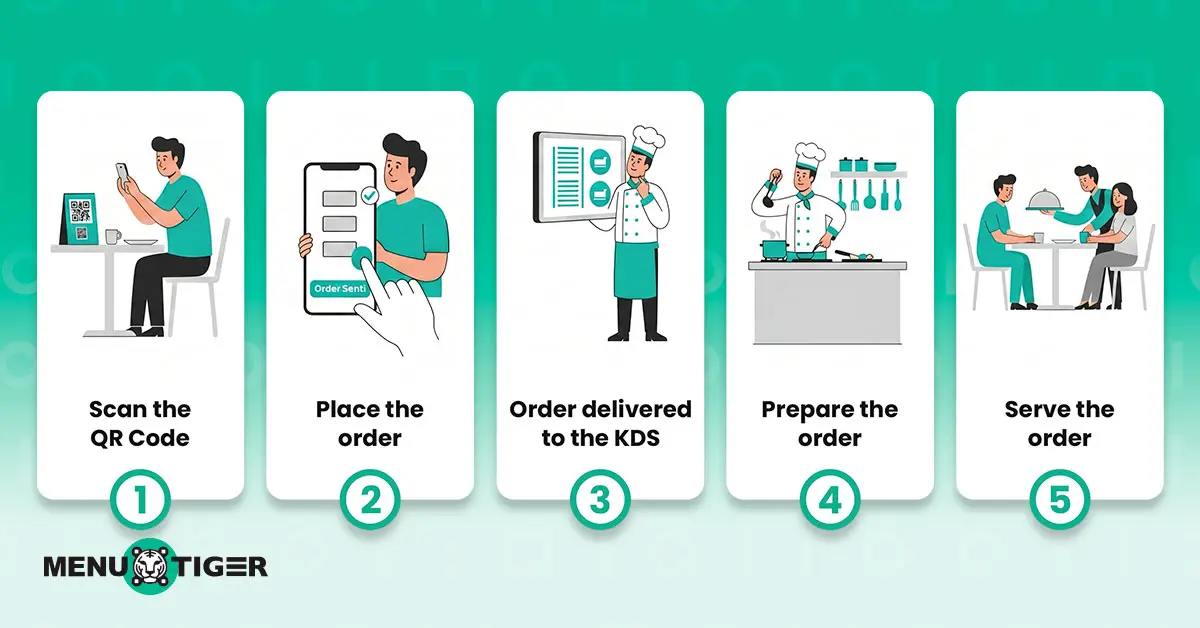
MENU TIGER workflow:
GloriaFood
Best for: Restaurants looking for a straightforward online ordering solution with minimal setup requirements.
GloriaFood provides essential digital ordering functionality through websites and online menu access.
Areas where it performs well:
- Website-based ordering
- Basic digital menu management
- Simple onboarding
- Lower operational complexity
- Direct online ordering setup
Trade-offs:
- Limited customization and branding flexibility
- Fewer built-in marketing capabilities
- Less coordination across multiple ordering channels
- Restaurants may need to prepare for migration planning before service sunset
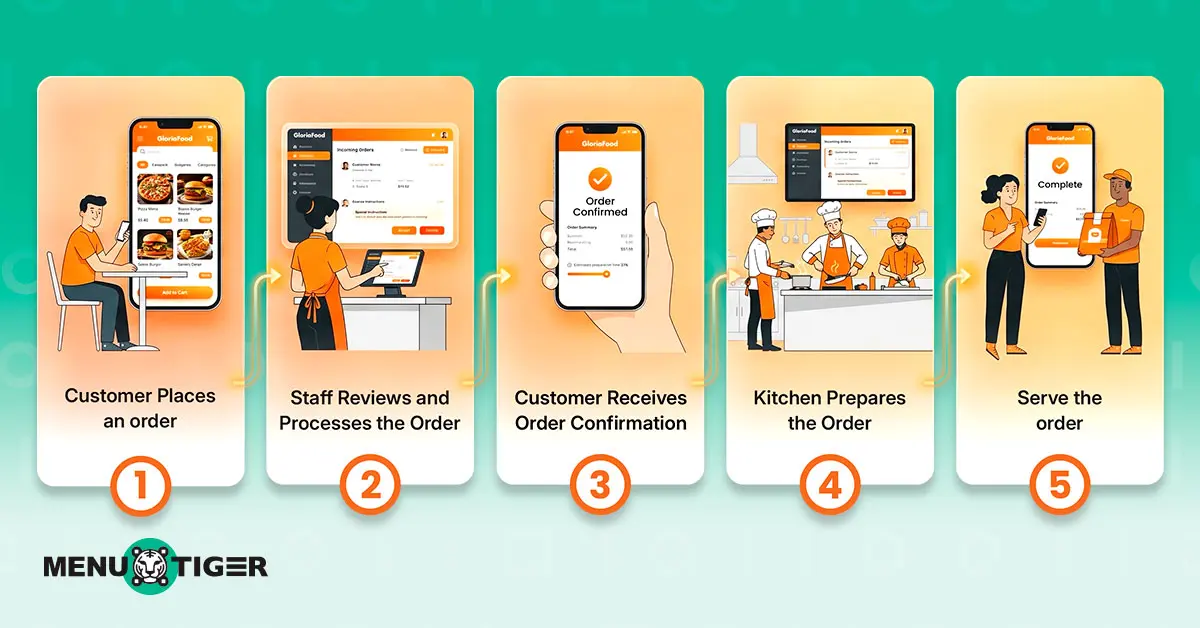
GloriaFood workflow:
| Overall insights: GloriaFood prioritizes a simpler ordering structure that may suit restaurants with straightforward digital needs. MENU TIGER emphasizes consolidating multiple ordering touchpoints, such as QR ordering, website ordering, and centralized menu management into one coordinated experience. For restaurants planning a transition, the decision between this restaurant technology may depend on factors such as operational complexity, growth plans, branding requirements, and how much control they want over the customer ordering experience. |
MENU TIGER vs GloriaFood: Feature Comparison
Ordering channels
How customers place orders can influence both customer experience and staff workflows. While both platforms support digital ordering, they differ in how ordering access is organized and presented.
| Operational Area | GloriaFood | MENU TIGER |
| QR code ordering | Customers access menus through QR codes and place orders digitally | Customers scan digital menu QR code to browse menus and place orders. |
| Website ordering | Ordering is handled through an embedded menu and ordering widget | Ordering takes place through a branded restaurant website with an integrated menu and checkout |
| Link-based ordering | Restaurants share a direct ordering link | Restaurants share a branded ordering page accessible across channels |
| POS integration | Supports selected integrations depending on setup | Supports POS integrations depending on configuration and operational requirements |
The primary difference is not the availability of ordering channels but how those channels are managed.
GloriaFood centers on a straightforward ordering entry point, while MENU TIGER combines contactless ordering systems such as QR, website, and shareable links into a connected ordering experience that can be managed under one system.
Ordering types and operations
Order management becomes increasingly important as restaurant volume grows. Both systems support common fulfillment methods, but the operational approach differs.
| Operational area | GloriaFood | MENU TIGER |
| Delivery management | Delivery areas and order settings are configured manually | Delivery settings are managed through a centralized ordering setup |
| Pickup and takeaway | Customers select pickup during checkout | Pickup and takeaway are integrated into the ordering flow |
| Kitchen order flow | Orders appear in a dashboard for preparation | Orders can be routed into a Kitchen Display System workflow |
| Order handling | Orders are processed individually | Orders from multiple ordering channels can be managed together |
GloriaFood focuses on keeping order handling straightforward.
MENU TIGER places more emphasis on coordination across order sources, which may benefit restaurants managing multiple channels or higher order volumes.
Menu management
Menu updates affect more than pricing; they influence customer experience, staff efficiency, and consistency across ordering channels.
| Operational area | GloriaFood | MENU TIGER |
| Menu setup | Restaurants manually create categories, items, and pricing | Restaurants can build menus manually or digitize menus using AI-assisted setup tools |
| Menu updates | Changes are updated individually | Updates can be synchronized across supported ordering channels |
| Menu display | Uses a standard ordering interface | Offers customizable menu layouts and branded presentation options |
The difference is less about editing menus and more about maintaining consistency.
GloriaFood keeps menu management simple and direct, while MENU TIGER emphasizes reducing repeated updates across multiple ordering touchpoints.
Restaurant tools and growth
Beyond accepting orders, restaurants often evaluate how a platform supports customer engagement, repeat business, and day-to-day marketing activities.
| Operational area | GloriaFood | MENU TIGER |
| Promotions | Restaurants create discounts and promotional offers | Promotional campaigns can be configured through ordering and marketing tools |
| Email marketing | Includes automated email marketing features | Supports email campaigns for customer engagement |
| Multi-channel promotion | Ordering links can be shared across digital channels | Ordering access can be distributed through QR, website, and direct links |
| Website builder | Provides a basic website to support ordering | Includes website creation with integrated ordering functionality |
| Onboarding resources | Set up guidance and documentation available | Structured onboarding materials and tutorials available |
Both platforms provide tools that support customer acquisition and retention.
GloriaFood focuses on individual tools for online ordering and promotion, while MENU TIGER places more emphasis on connecting customer engagement with ordering workflows.
Analytics and insights
Reporting and visibility can influence how restaurants adjust menus, manage performance, and identify operational opportunities.
| Operational area | GloriaFood | MENU TIGER |
| Sales reporting | Provides order and revenue summaries | Displays sales performance through dashboards and reporting views |
| Order history | Stores historical order records | Centralizes order history for review and tracking |
| Performance monitoring | Offers visibility into ordering activity | Includes order and menu performance monitoring |
| Customer information | Stores customer and transaction details | Organizes customer and order data for operational review |
| Data exports | Reports can be exported | Reporting data can be exported for analysis and record-keeping |
Both systems provide visibility into restaurant performance. The distinction is largely in how data is organized.
GloriaFood prioritizes simplicity, while MENU TIGER expands reporting into a broader operational overview.
Integrations and payments
Restaurants rarely operate with a single tool. Integration flexibility and payment setup can influence how smoothly systems fit existing workflows.
| Operational area | GloriaFood | MENU TIGER |
| Third-party integrations | Supports integrations through available APIs and supported partners | Supports POS and operational integrations depending on setup |
| Online payments | Connects through external payment gateways | Supports payment integrations, including available online payment providers |
Both platforms rely on integrations to extend functionality.
Restaurants evaluating either option should confirm payment availability, POS compatibility, and operational requirements before migrating.
GloriaFood and MENU TIGER use cases
Different restaurant models prioritize different operational needs. The right fit often depends on order volume, customer experience goals, and workflow complexity.
GloriaFood may fit:
| Restaurant type | Typical fit |
| Quick service restaurants | Supports straightforward online ordering |
| Fast-casual restaurants | Works for pickup and delivery operations |
| Cafes and coffee shops | Enables digital ordering and takeaway |
| Casual dining | Supports website-based ordering |
| Cloud kitchens | Supports delivery-focused operations |
| Bakeries and dessert shops | Works for scheduled ordering and pickup |
| Takeout-focused restaurants | Supports direct ordering channels |
MENU TIGER may fit:
| Restaurant type | Typical fit |
| Quick service restaurants | Supports QR-enabled ordering experiences |
| Fast-casual restaurants | Coordinates dine-in and takeaway workflows into one dashboard |
| Cafes and coffee shops | Supports mobile-first ordering experiences |
| Casual dining | Helps organize digital ordering touchpoints |
| Cloud kitchens | Centralizes incoming online orders |
| Bakeries and dessert shops | Supports pre-order and pickup workflows |
| Takeout and delivery restaurants | Supports direct ordering management |
Key takeaway:
Restaurant size alone does not determine fit.
Restaurants with simpler ordering requirements may prioritize ease of use, while restaurants expanding digital channels may prioritize coordination and operational flexibility.
Why restaurants consider migrating to MENU TIGER
1. Improved operational structure
This solution is a restaurant management software that combines ordering, menu management, and customer interaction tools into a single system designed for centralized control.
2. Cost and flexibility balance
It is positioned as a scalable solution that supports both small and growing restaurant operations without requiring enterprise-level systems.
3. Shift toward digital-first ordering.
As customer behavior continues moving toward QR and mobile ordering, MENU TIGER supports these workflows natively.
4. Scalability for growth
The system is designed for scalability and handles multiple branches and higher-order volumes without fragmenting operations.
5. Simplified setup process
Restaurants can quickly digitize menus with their AI and begin accepting orders through QR or web-based systems with minimal setup steps.
Keep the orders flowing beyond 2027.
GloriaFood vs MENU TIGER differ in structure, flexibility, and long-term scalability, but they both support core online ordering functions.
As GloriaFood approaches its phase-out in 2027, restaurants will need to evaluate not only feature similarities but also how each system supports future operational needs.
The transition is less about replacing a tool and more about choosing a platform that aligns with evolving restaurant workflows, customer expectations, and digital ordering trends.