
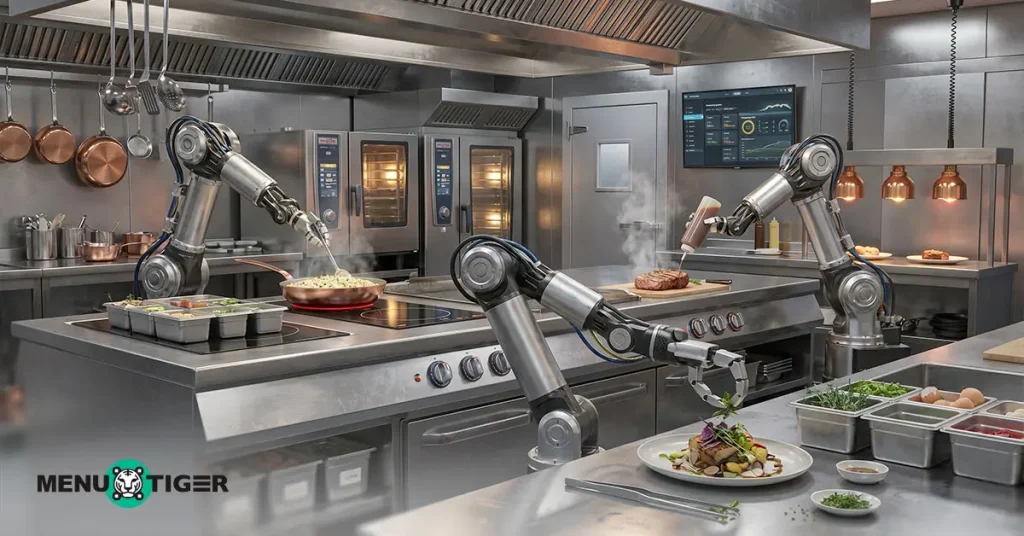
Smart kitchen address operational bottlenecks. Slow order processing? Miscommunication? Food wastes? Inconsistent quality and rising costs? These will just be a relic of outdated kitchen systems.
As the demand for speed and consistency continues to grow, restaurants are no longer asking whether to adopt these technologies, but how quickly they can integrate them.
But just so it’s clear: this is not about replacing chefs and other staff. This is about improving execution under real service conditions.
So how does this advanced kitchen work?
A smart kitchen is a kitchen that uses connected technology, automation, and intelligent devices to improve how food is prepared, managed, and operated.
Instead of manual tracking, processes are integrated through connected systems. For example, orders route from digital menus to kitchen displays, inventory updates in real time, and equipment performance is monitored continuously.
In practice, this shifts the kitchen from a reactive workspace to a controlled, data-driven production system.

The widespread adoption of smart kitchen technology: What the data says
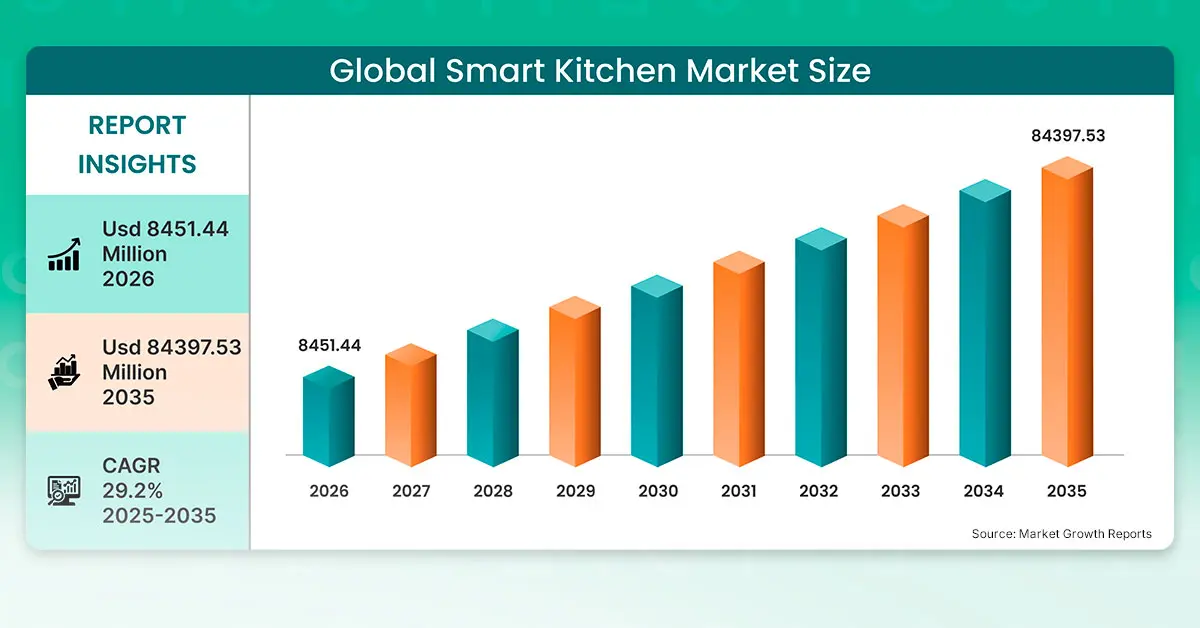
Valued at approximately $8.4 million in 2026, the industry is projected to exceed $84 million by 2035, nearly ten times its current value. This rapid expansion is driven by a 29.2% CAGR, reflecting robust demand.
At the core of this growth is the increasing adoption of kitchen technologies, particularly in commercial kitchen environments, restaurants, quick-service chains, and cloud kitchens.
But this raises a critical question:
Why is there such widespread global adoption?
After further industry research, here’s what we found out:
- 30% reduction in operational costs achieved through smart cooking equipment and robotic fry stations (QSR Web, 2025).
- 10–15% energy savings compared to traditional kitchen appliances, thanks to more efficient, sensor-driven systems (ScienceDirect, 2026).
- 20% reduction in labor costs as AI tools automate routine and repetitive kitchen tasks (ZipDo, 2026).
- 15–25% faster ticket times within the first month of implementing kitchen display systems, improving overall service speed (KwickOS, 2026).
- 31% reduction in over-ordering, translating to approximately $18,000–$45,000 in annual savings for a typical $1M–$2M revenue restaurant (US Tech Automation, 2026).
- 60% food waste potential when using smart refrigerators with sensors and AI tracking to monitor inventory and expiration in real time (ScienceDirect, 2026).
Industry data shows restaurant technology like kitchen systems are not futuristic gadgets but tools for solving everyday operational problems.
Examples of modern smart restaurant kitchen systems
When people hear “smart technology” they often think it’s something complex or futuristic technology in kitchen appliances In reality, many smart systems for kitchens are already being used, and they’re surprisingly practical.
1. Restaurant order management system
An integrated restaurant order management system centralizes orders from dine-in, takeaway, online ordering, and delivery apps into one platform.
This eliminates the need for staff to manually manage multiple devices or tablets.
Orders from are restaurant ordering system automatically routed to the kitchen in real time, helping restaurants reduce missed orders, improve workflow efficiency, and deliver faster customer service.
2. Kitchen Display System (KDS)
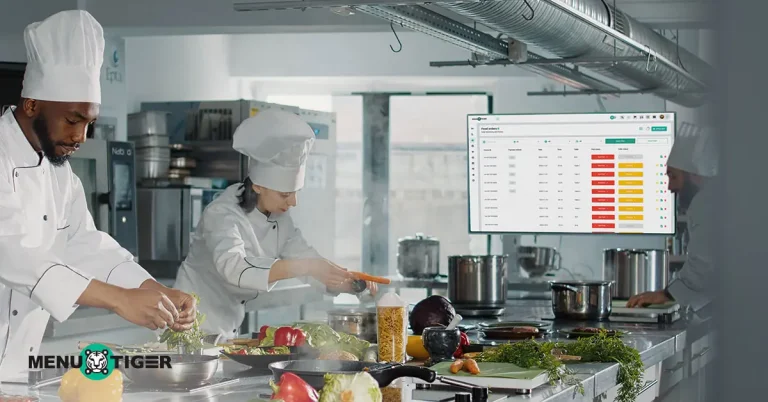
A Kitchen Display System replaces traditional handwritten tickets and printed order slips with digital kitchen screens.
Once an order is placed through the digital menu, the KDS displays:
- Item details
- Modifications
- Preparation priority
- Special instructions
- Ticket timing
This allows kitchen staff to organize workflow more efficiently while improving preparation accuracy and reducing delays during peak hours.
3. Inventory management system
Smart inventory management systems automatically track ingredient usage, stock levels, expiration dates, and purchasing needs in real time.
Instead of manually counting inventory, restaurant owners can receive low-stock alerts, monitor food waste, and forecast future inventory requirements more accurately.
This helps reduce unnecessary waste, avoid ingredient shortages, and improve overall profitability.
4. Real-time analytics and reporting
Kitchen tech provides real-time business insights through data analytics dashboards that track sales performance, preparation times, ingredient consumption, food waste, and customer ordering trends.
These reports help restaurant owners make better operational decisions, identify bottlenecks, optimize menu performance, and improve profitability using actual data instead of guesswork.
5. AI-powered demand forecasting
AI for restaurants helps restaurants predict customer demand by analyzing historical sales data, weather patterns, seasonal trends, and customer behavior.
Demand forecasting allows restaurant owners to optimize staffing schedules, improve inventory planning, and reduce over-ordering or ingredient shortages.
This leads to better operational efficiency and lower food waste.
6. Staff performance tracking
Smart systems can monitor staff productivity, preparation speed, task completion, and kitchen workflow performance.
Managers can identify operational bottlenecks, improve employee training, and optimize staff scheduling based on performance data.
This helps restaurants build more efficient teams while improving overall kitchen productivity.
7. Predictive equipment maintenance
High-tech kitchen equipment can monitor appliance performance and detect maintenance issues before breakdowns occur.
These systems send alerts when equipment requires servicing or shows signs of malfunction.
Predictive maintenance helps restaurants avoid unexpected downtime, expensive repairs, and service interruptions that could impact customer satisfaction.
8. Energy saver management system
An Energy Management System (EMS) works by using simple devices like smart plugs, energy meters, or built-in sensors that are attached to kitchen equipment such as ovens, fryers, and refrigerators.
These tools track how much electricity each appliance uses in real time. The data is then sent through to a central dashboard, usually cloud-based, where it is collected and organized in an easy-to-read format.
9. Internet of Things (IoT)
Internet of Things technology allows kitchen equipment and systems to communicate with each other automatically.
Connected refrigerators, ovens, inventory systems, and kitchen displays can share real-time information to improve efficiency and food safety.
For example, smart refrigerators can send alerts if temperatures exceed safe food storage levels, helping restaurants avoid spoilage and compliance issues.
10. Sensor and automation
Motion sensors can control lighting and reduce energy waste, while temperature sensors ensure food safety in storage areas.
Automated systems can manage timers, cooking cycles, and equipment settings without manual input, helping reduce human error and improve efficiency.
Brands that offer the best high-tech kitchen appliances
Here are top brands that offers advanced kitchen appliances:
1. Samsung
System: SmartThings
Samsung is one of the strongest brands in terms of device connectivity and ecosystem integration, especially for environments managing multiple smart devices.
What it offers:
- Strong ecosystem integration across compatible appliances
- Centralized control through one platform (SmartThings)
- Automation features for supported devices (routines and scheduling)
- Remote monitoring of appliance status
- Works well for multi-location or multi-device setups
2. LG
System: ThinQ
LG focuses on smart monitoring, diagnostics, and efficiency tracking using its ThinQ platform.
What it offers:
- Appliance diagnostics and maintenance alerts
- Energy usage tracking for efficiency management
- Remote monitoring and control
- AI-based suggestions based on usage patterns (optimization, not full automation learning)
- Helps reduce unexpected downtime through alerts
3. GE Appliances
System: SmartHQ
GE Appliances provides a more straightforward smart system designed for ease of use. One advantage is that they reduce training complexity for staff with simple digital controls.
What it offers:
- Simple remote monitoring and control
- Notifications for appliance status and cycle completion
- Guided cooking features on select models
- Software updates for performance improvements
- User-friendly interface for quick staff training
4. Bosch
System: Home Connect
Bosch is widely known for engineering reliability and system stability, which is critical in restaurant environments. This system helps reduce downtime through reliable diagnostics and performance stability.
What it offers:
- Remote diagnostics for maintenance support
- Energy monitoring and efficiency tracking
- Stable connectivity for supported appliances
- Integration with voice assistants (in compatible systems)
5. Whirlpool
System: Whirlpool App
Whirlpool offers entry-level smart functionality suitable for basic operational needs. It provides basic remote monitoring without system complexity, which is suitable for small restaurants or kitchens needing simple digital control systems.
What it offers:
- Remote diagnostics for troubleshooting and maintenance support
- Energy efficiency tracking in supported appliances
- Stable and consistent connectivity
- Voice assistant compatibility (in supported ecosystems)
- Strong focus on long-term durability and performance stability
5 restaurants with advanced kitchen systems
Here’s how a smart restaurant system works in quick-service restaurants and other types of food establishments.
1. CaliExpress
Restaurants like CaliExpress by Flippy in California use Flippy to handle high-volume cooking tasks.
Developed by Miso Robotics, Flippy is an AI-powered kitchen robot that operates fry and grill stations efficiently.
It uses computer vision and machine learning to track cooking times, detect doneness, and make real-time adjustments, helping ensure consistent food quality with less manual supervision.
2. McDonald’s
McDonald’s uses self-serve kiosk, integrated POS systems, and kitchen display systems (KDS) in many branches.
Customers can place orders through kiosks or mobile apps, which are then sent directly to kitchen screens for preparation.
In some locations, these systems are also connected to drive-thru and delivery platforms, allowing all orders to be managed in a single, synchronized queue.
3. Sweetgreen
Sweetgreen partnered with Spyce (later acquired by Sweetgreen) and automation engineers to develop its “Infinite Kitchen.”
Instead of fully manual assembly, ingredients are stored in automated dispensers above a conveyor system. When an order is placed, the system portions and assembles ingredients step-by-step as the bowl moves along the line.
Software controls portioning, sequencing, and timing, while staff mainly handle prep and oversee operations.
4. iWok
iWok is a fast-casual Asian restaurant in Houston, Texas, that uses robotic wok technology to prepare meals.
Once an order is placed, ingredients are automatically loaded into an electric spinning wok that heats, rotates, and stirs the food using preset cooking settings for temperature, timing, and motion.
After cooking, the meal is dispensed into a container for serving. Staff mainly handle prep, restocking, and supervision, while the system ensures consistent, automated cooking.
5. KFC
KFC has experimented with kitchen automation in China and selected pilot locations, including robotic frying systems and automated cooking stations for fried chicken.
These systems regulate oil temperature, cooking time, and food handling using sensors and programmed controls to ensure consistency, with some setups using robotic arms to assist in frying tasks.
However, these technologies remain in trial or limited deployment rather than full global rollout.
The pros and cons of kitchen technology in a restaurant
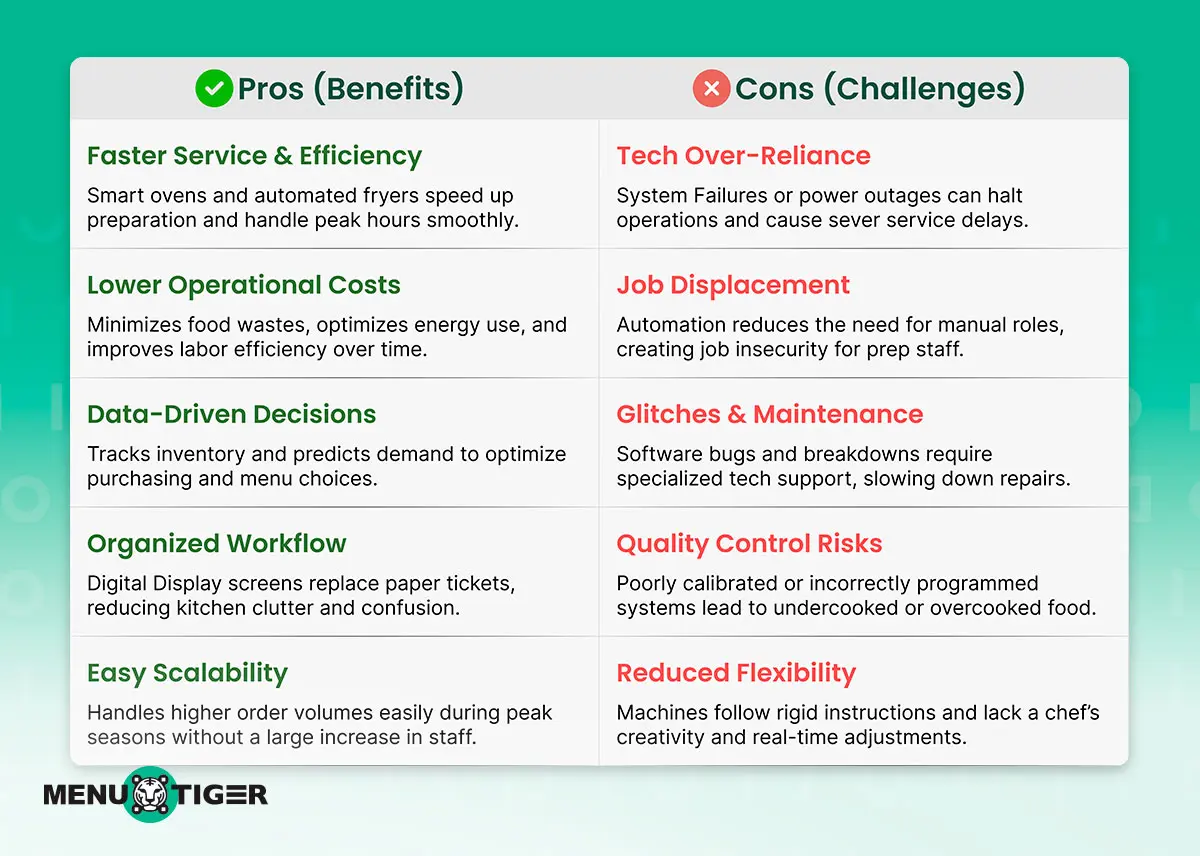
Kitchen automation system is not a trend; it’s now the new standard.
The impact of kitchen technology is already clear. They deliver faster service, reduce waste, lower costs, and improve food consistency across operations, although challenges like setup costs and reliance on technology remain.
This transformation does not stop in the kitchen. With systems that offers smart kitchen apps like Samsung, LG, GE Appliances, Bosch, and Whirlpool.
Restaurant operations extend to the front of the house, linking ordering, kitchen flow, and service into a single system.
The future of food service is not about replacing the kitchen. It is about making the entire restaurant smarter, more connected, and more efficient.